


Introduction
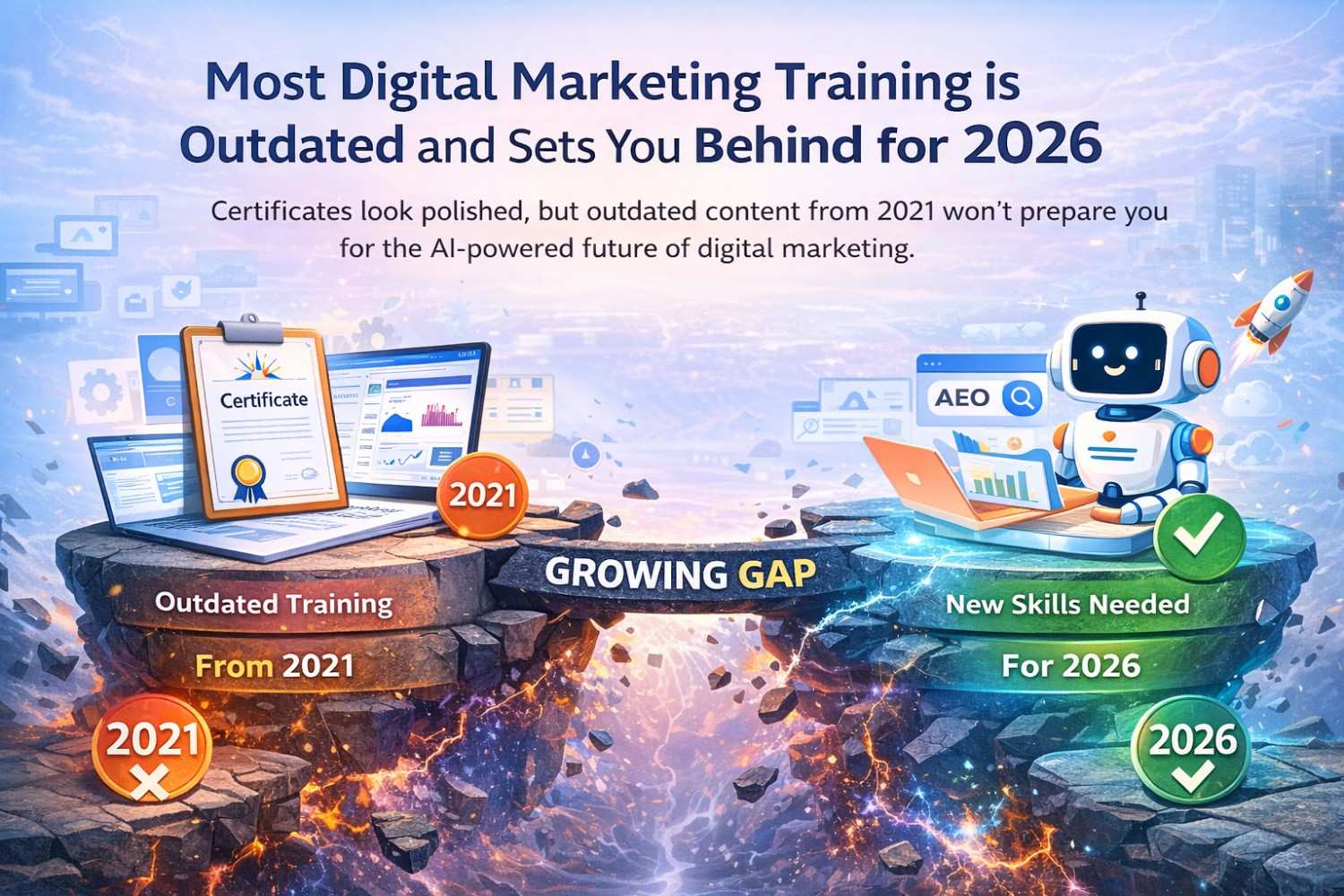
Roughly 1.5 million people search for digital marketing training every month globally. The overwhelming majority end up on a course that teaches them what digital marketing looked like in 2021.
That is the problem nobody talks about. The platforms are polished, the certificates look credible, and the syllabuses sound comprehensive. But the gap between what most digital marketing training programmes teach and what employers actually need in 2026 has never been wider.
AI has restructured the entire discipline. Search has fractured across platforms. Answer engines like ChatGPT and Perplexity are changing how content gets discovered. Performance marketing now demands a fluency with automation tools that simply did not exist two years ago. Digital marketing training that does not reflect this is not neutral — it is actively misleading to the people who invest in it.
This article explains exactly what digital marketing training is, what it must include in 2026, and how to evaluate whether a programme is genuinely worth your time and money.
What Is Digital Marketing Training?
Digital marketing training is a structured programme designed to develop the knowledge, skills and practical capability to plan, execute and measure marketing activity across digital channels. It covers disciplines including search engine optimisation, paid advertising, content strategy, email marketing, social media, analytics and — in any credible 2026 programme — AI tools and automation.
The key word is practical. Training implies the development of an applied skill, not just awareness of a topic. Someone who has completed genuine digital marketing training can open a campaign manager, write a brief, interpret an analytics report and make a decision — not just define what those things are.
That distinction matters because most programmes confuse education with training. Watching a video about Google Ads is education. Running a real Google Ads campaign with a budget, an objective and a result is training.
Why Digital Marketing Training Has Changed Completely in 2026
The AI Shift Is Not Optional
According to HubSpot’s 2025 State of Marketing report, 68% of marketers now use AI tools in their daily workflow. That figure has more than doubled in two years. Any digital marketing training programme that does not build genuine AI fluency — not a bolt-on module, but integrated AI thinking throughout — is preparing people for a job market that no longer exists.
AI has changed not just the tools marketers use but the logic of how marketing works. Content is now discovered through AI-generated answers, not just search results. Campaigns are optimised by machine learning, not just manual bidding. Audiences are segmented by behavioural signals, not just demographics. Training that ignores this is fundamentally incomplete.
Search Has Fractured Across Platforms
Google remains dominant, but in 2026 search behaviour is distributed across TikTok, Instagram, YouTube, ChatGPT, Perplexity and Reddit in ways that require a fundamentally different approach to visibility. Traditional SEO training — optimise a page, build links, check rankings — is necessary but nowhere near sufficient.
Credible digital marketing training now must include answer engine optimisation (AEO), which is the practice of structuring content so that AI systems can extract and cite it in direct answers. It must include social search strategy. It must address how platforms like TikTok and YouTube function as discovery engines in their own right.
Employers Are Hiring for Execution, Not Awareness
A 2024 LinkedIn Talent Trends report found that 73% of marketing hiring managers prioritise demonstrable portfolio evidence over formal qualifications. The question they are asking at interview is not “did you study this?” It is “have you done this, and can you show me the results?”
Digital marketing training that does not produce portfolio evidence — real campaigns, real results, real case studies — is not producing what the market is buying.

What Should Digital Marketing Training Include in 2026?
Any professional digital marketing training programme worth investing in should cover the following disciplines, not as isolated modules but as an integrated system.
Strategy and research frameworks. Before any channel or tool, training should develop the ability to think strategically — to understand audiences, define objectives, and build a coherent plan. This is the foundation everything else sits on.
Copywriting, messaging and positioning. The ability to communicate clearly and persuasively is the most transferable skill in marketing. It applies to every channel. Yet most training programmes treat it as an afterthought. Strong digital marketing training builds this capability explicitly.
SEO across all platforms and answer engine optimisation. Search engine optimisation for Google, plus AEO for ChatGPT, Perplexity and AI Overviews, plus social search strategy for TikTok and YouTube. All three are required in 2026.
Performance marketing. Google Ads, Meta Ads, and paid acquisition strategy with a genuine understanding of budgeting, bidding, audience targeting and return on investment. Not just platform navigation — commercial thinking.
Social media and content strategy. How content is planned, produced and distributed across platforms. How algorithms work. How to build and convert an audience. How to measure what matters.
Email marketing and automation systems. Building retention, nurture sequences and scalable communication workflows. Email remains one of the highest-ROI channels in digital marketing and is consistently undertaught.
AI workflows and marketing automation. How to use AI tools to increase efficiency, improve output quality and build competitive advantage. This is not a separate subject — it runs through every other discipline.
Analytics, attribution and reporting. The ability to connect marketing activity to business outcomes. How to set up measurement correctly, interpret data honestly and make decisions from it. This is what separates junior marketers from people who get promoted.
The Difference Between Online Digital Marketing Training and a Real Programme
Not all online digital marketing training is equal, and the format matters less than most people think. The question is not whether training is delivered online or in person. It is whether it produces real capability.
The markers of genuine professional digital marketing training are consistent regardless of format. Real project work on actual campaigns. Direct access to a mentor with verifiable commercial experience. A curriculum that reflects 2026 — not 2021. A credential issued by an organisation with a trackable professional reputation.
Programmes that offer video content, quizzes and a completion certificate at the end are not training. They are self-study resources. Both have their place, but conflating the two leads people to invest in the wrong thing for their actual goal.
Elvijs Plugis on What Good Training Actually Looks Like
“I have delivered digital marketing training to corporate teams across the UK, Europe, UAE and India — and the same gap appears everywhere. People arrive having completed courses. They can name the tools. They can describe the concepts. But the moment you put a real brief in front of them, the wheels come off.
Real training changes behaviour. It changes how someone thinks about a campaign, how they structure a brief, how they read data. That only happens through doing, not watching. Every element of the programme I have built at Techtadd is designed around execution — because that is the only kind of training that actually transfers to a job or a client. Companies pay me £14,000 to deliver this to their senior teams. The fact that I have made it accessible for £499 is a deliberate decision, not an accident.”
Elvijs Plugis is the Founder and CEO of Sigulp and Director of Techtadd. An MCIM-accredited marketer and G20 Golden 100 Honouree, he has worked across 500-plus international projects spanning the UK, USA, Europe, India and the GCC. The Digital Marketing UK Internship Course at digitalmarketinginternshipcourse.com is built on the same frameworks he delivers to corporate clients.
External link: HubSpot State of Marketing Report 2025
Frequently Asked Questions
What is digital marketing training?
Digital marketing training is a structured programme that develops practical skills across the core disciplines of digital marketing — including SEO, paid advertising, content strategy, email marketing, social media, analytics and, in 2026, AI tools and automation. Unlike purely educational courses, genuine training builds applied capability through real campaign work and measurable outputs.
What should digital marketing training include in 2026?
In 2026, digital marketing training must cover AI tools and workflows, answer engine optimisation (AEO) for ChatGPT and Perplexity, social search strategy, performance marketing, email automation, analytics and copywriting. Programmes that do not address the AI shift in search and campaign management are teaching an outdated skill set.
What is the difference between online digital marketing training and a course?
The terms are often used interchangeably, but the meaningful distinction is whether the programme builds practical, portfolio-level capability or simply delivers content. Genuine digital marketing training involves real project work, mentor feedback and measurable outputs. A course that delivers video modules and a completion certificate is self-study, not training.
How long should digital marketing training take?
Quality digital marketing training typically runs between eight and twelve weeks when delivered intensively. Shorter programmes rarely cover the full discipline with enough depth for professional application. Longer self-paced programmes risk losing practical momentum. A 12-week structured programme with weekly live project work is the format most consistent with genuine skill development.
Is practical digital marketing training better than theoretical training?
Yes, decisively. According to LinkedIn’s 2024 Talent Trends report, 73% of marketing hiring managers prioritise portfolio evidence over qualifications. Theoretical knowledge without applied experience does not satisfy what employers are looking for. Practical digital marketing training — where participants work on real campaigns and produce real results — is the only format that produces hireable outcomes.
What is certified digital marketing training and does certification matter?
Certified digital marketing training is a programme that issues a formal credential on completion, issued by a named organisation with a verifiable professional reputation. Certification matters when the issuing organisation is credible — a UK-recognised certificate from a professional training provider carries more weight than a platform badge. The certificate confirms context. The portfolio demonstrates capability. Both are needed.
Ready to Get Digital Marketing Training That Actually Works?
If you are serious about building a real digital marketing career in 2026 — not just collecting certificates — the Digital Marketing UK Internship Course gives you the skills, experience and UK credentials employers actually hire for.
12 weeks. Real London company projects. AI era curriculum. Led personally by Elvijs Plugis.
Enrol now — April 2026 cohort openQuestions? Contact Elvijs directly: elvijs@sigulp.co.uk or WhatsApp

Comments are closed