


Introduction
Most digital marketing training programmes claim to be job-oriented. Almost none of them have designed their programme around what actually gets people hired.
The phrase “job-ready” or “job-oriented” has become standard marketing language across online education. It appears on the landing pages of video course platforms, self-paced certificate programmes and generic academies alike — often with no definition of what job-ready means, no evidence of employment outcomes, and no structural commitment to producing them.
If getting a job — or winning clients, or advancing your career — is your actual goal, this distinction matters enormously. Job-oriented digital marketing training is not a tone of voice. It is a design principle that determines everything from curriculum content to project structure to the credential issued at the end.
This guide explains what that design principle looks like in practice, what the 2026 job market is actually hiring for, and how to evaluate whether a programme is genuinely built around your employment outcome.
External link: LinkedIn Talent Trends Report 2024
What Does Job-Oriented Digital Marketing Training Actually Mean?
Job-oriented digital marketing training is a programme explicitly designed to produce the outcomes employers are hiring for — not just the knowledge they might find useful.
The distinction is significant. A knowledge-oriented programme asks: what should a digital marketer understand? A job-oriented programme asks: what does a hiring manager need to see before they make an offer? These are different questions, and they produce different curricula.
The 2026 answer to the second question is consistent across the UK job market and increasingly across global markets too. Hiring managers want portfolio evidence of real campaign work. They want demonstrable AI fluency. They want candidates who can sit down, open a platform and execute — not candidates who can explain what execution involves.
Job-oriented digital marketing training is built backwards from that requirement. Every element — the curriculum, the project structure, the mentorship model, the credential — is chosen because it produces what the market is buying.
What the 2026 Job Market Is Actually Hiring For
Portfolio Evidence Over Qualifications
According to LinkedIn’s 2024 Talent Trends report, 73% of marketing hiring managers now prioritise demonstrable portfolio evidence over formal qualifications when evaluating candidates. This is not a marginal shift. It represents a fundamental change in how hiring decisions are made in the marketing industry.
A portfolio built on real campaign work — actual businesses, actual platforms, actual results — answers the question every hiring manager is asking before they ask it. It demonstrates not just that you know what digital marketing is, but that you have done it and produced something measurable as a result.
Job-oriented digital marketing training is designed to produce this portfolio as a primary output, not as an afterthought.
AI Fluency as a Baseline Expectation
HubSpot’s 2025 State of Marketing report found that 68% of marketers now use AI tools in their daily workflow. In the UK’s leading agencies and in-house teams, AI fluency is no longer a differentiator — it is a baseline expectation for anyone entering the profession.
This means job-oriented training in 2026 must integrate AI throughout the curriculum. Not as a standalone module. Not as an optional add-on. As a thread running through every discipline — SEO, content, performance marketing, email, analytics — because that is how AI functions in actual marketing practice.
Candidates who emerge from a programme without genuine AI fluency are immediately at a disadvantage in any competitive hiring process.
The Ability to Communicate Results
One of the most consistent gaps in junior marketing candidates — identified repeatedly in hiring manager feedback — is the inability to talk about their work in commercial terms. They can describe what they did. They cannot explain what it produced, why it mattered, or what they would do differently.
Job-oriented digital marketing training develops this capability explicitly. Working on real campaigns with real objectives produces the language of commercial outcomes — traffic, conversion, cost-per-acquisition, return on ad spend — that transforms a portfolio item from a project description into a business case.
What Separates Job-Oriented Programmes From the Rest
Built Around Real Project Work, Not Curriculum Completion
The most reliable indicator of a genuinely job-oriented programme is whether real project work is the structural centre of the programme — not an addition to it. Every week should produce a deliverable that goes into a portfolio. Every brief should come from a real business with a real objective. Every result should be measurable.
Programmes built around curriculum completion — where the project work is a module near the end — are not job-oriented. They are knowledge programmes that have added a capstone project for marketing purposes.
Direct Mentorship from a Working Practitioner
Job-oriented training requires mentorship from someone who understands what the job market is currently hiring for — because they are operating within it. A working CMO who is actively advising businesses, running campaigns and training corporate teams brings current, commercial insight that an academic educator or content creator cannot provide.
The mentor’s role in a job-oriented programme is not just to teach. It is to evaluate work against the standard the market applies, to push candidates toward the level of output that opens doors, and to provide the kind of strategic feedback that develops professional judgement alongside practical skill.
A Credential That Employers Recognise
A job-oriented programme issues a credential that means something to the employers the programme is preparing participants to approach. For UK employers and international hiring managers targeting the UK market, a certificate from a UK-based professional training organisation — issued by a body with a verifiable reputation — carries weight that generic platform badges do not.
The credential matters because it signals to a hiring manager that the experience was structured, supervised and held to an external standard. Combined with a portfolio of real campaign work, it provides the complete professional picture that moves a candidate from application to interview.
How the Digital Marketing UK Internship Course Is Designed Around Employment
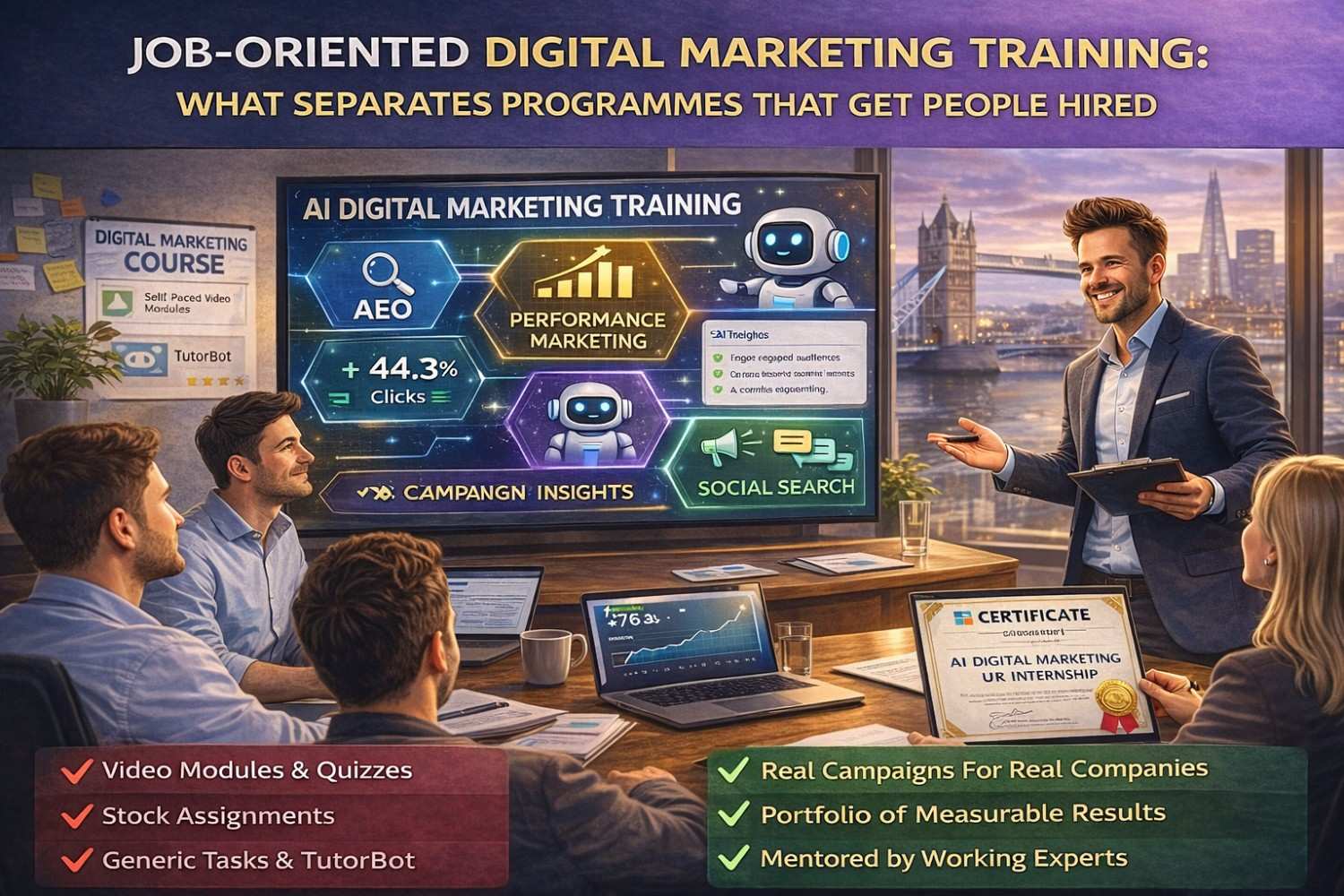
The Digital Marketing UK Internship Course by Techtadd was designed explicitly around the question: what does someone need to be genuinely hireable in the 2026 digital marketing job market?
The answer built into the programme is a portfolio of real London company campaign work, a UK-issued internship certificate from Techtadd, and a 12-week AI-era curriculum covering the full digital marketing stack — SEO, AEO, performance marketing, email automation, social search, AI workflows and analytics.
Every week of the programme produces real project work. Every project brief comes from an actual London business. Every piece of work is reviewed and guided by Elvijs Plugis — Founder and CEO of Sigulp, Director of Techtadd, MCIM-accredited marketer, G20 Golden 100 Honouree, and the practitioner behind 500-plus international projects across the UK, USA, Europe, India and the GCC.
The programme is 100% online and open globally. The price is £499 one-time or £299 per month.

Elvijs Plugis on What Job-Oriented Training Actually Requires
“I have been hiring marketers, advising on hiring decisions and watching people fail to get jobs they were capable of doing for fifteen years. The pattern is the same every time. The candidates who struggle in interviews are not the ones who lack knowledge. They are the ones who lack evidence.
They can talk about SEO. They cannot show a campaign they ranked. They can describe email marketing. They cannot show a sequence they built and the open rates it produced. They know about AI tools. They have not used them on a real brief.
Job-oriented training closes that gap. Every decision I made in building this programme came back to one question: will this produce something a hiring manager will take seriously? If the answer was no, it did not make the cut.”
Frequently Asked Questions
What is job-oriented digital marketing training?
Job-oriented digital marketing training is a programme explicitly designed to produce the outcomes employers are hiring for — real portfolio evidence, AI fluency, measurable campaign results and a credible UK-recognised credential. It is built backwards from what hiring managers evaluate, not forward from what is convenient to teach.
What does the 2026 digital marketing job market look for in candidates?
Hiring managers in 2026 primarily look for portfolio evidence of real campaign work, demonstrable AI fluency across tools and platforms, and the ability to communicate results in commercial terms. According to LinkedIn’s 2024 Talent Trends report, 73% of marketing hiring managers now prioritise portfolio evidence over formal qualifications.
How is job-oriented digital marketing training different from a standard course?
A standard course is built around curriculum completion — transferring knowledge through videos, quizzes and reading materials. Job-oriented digital marketing training is built around employment outcomes — producing portfolio evidence, developing AI fluency through live project work and issuing a credential that employers recognise. The output is a hireable profile, not a completion certificate.
What should job-ready digital marketing training include?
Real project work on live campaigns for actual businesses, an AI-era curriculum covering SEO, AEO, performance marketing, email automation and analytics, direct mentorship from a working practitioner, and a UK-recognised certificate from a professionally credible organisation. Without all four, a programme claiming to be job-oriented is making a marketing claim it cannot support.
Can international candidates benefit from job-oriented digital marketing training in the UK?
Yes — significantly. A UK-issued internship certificate combined with a portfolio built on real London company campaigns is a powerful differentiator for candidates from India, the USA, Canada, Singapore, Saudi Arabia and other markets targeting UK employers or international remote roles. The programme is 100% online and accessible globally.
How long does job-oriented digital marketing training take?
A genuinely job-oriented programme needs enough time to produce a substantive portfolio — typically 10 to 12 weeks of structured, weekly project work. Shorter programmes do not produce sufficient portfolio depth. The Digital Marketing UK Internship Course runs for 12 weeks, producing a portfolio of real campaign work alongside a UK-issued internship certificate.
Ready for Digital Marketing Training Built Around Getting You Hired?
If you are serious about building a real digital marketing career — not just collecting certificates — the Digital Marketing UK Internship Course gives you the skills, experience and UK credentials employers actually hire for.
12 weeks. Real London company projects. AI era curriculum. Led personally by Elvijs Plugis.
Questions? Contact Elvijs directly: elvijs@sigulp.co.uk or WhatsApp

Comments are closed